

The early years of a child’s life are an important period of growth and learning. During this stage, children develop language, social skills, curiosity, confidence, motor skills, and an understanding of the world around them.
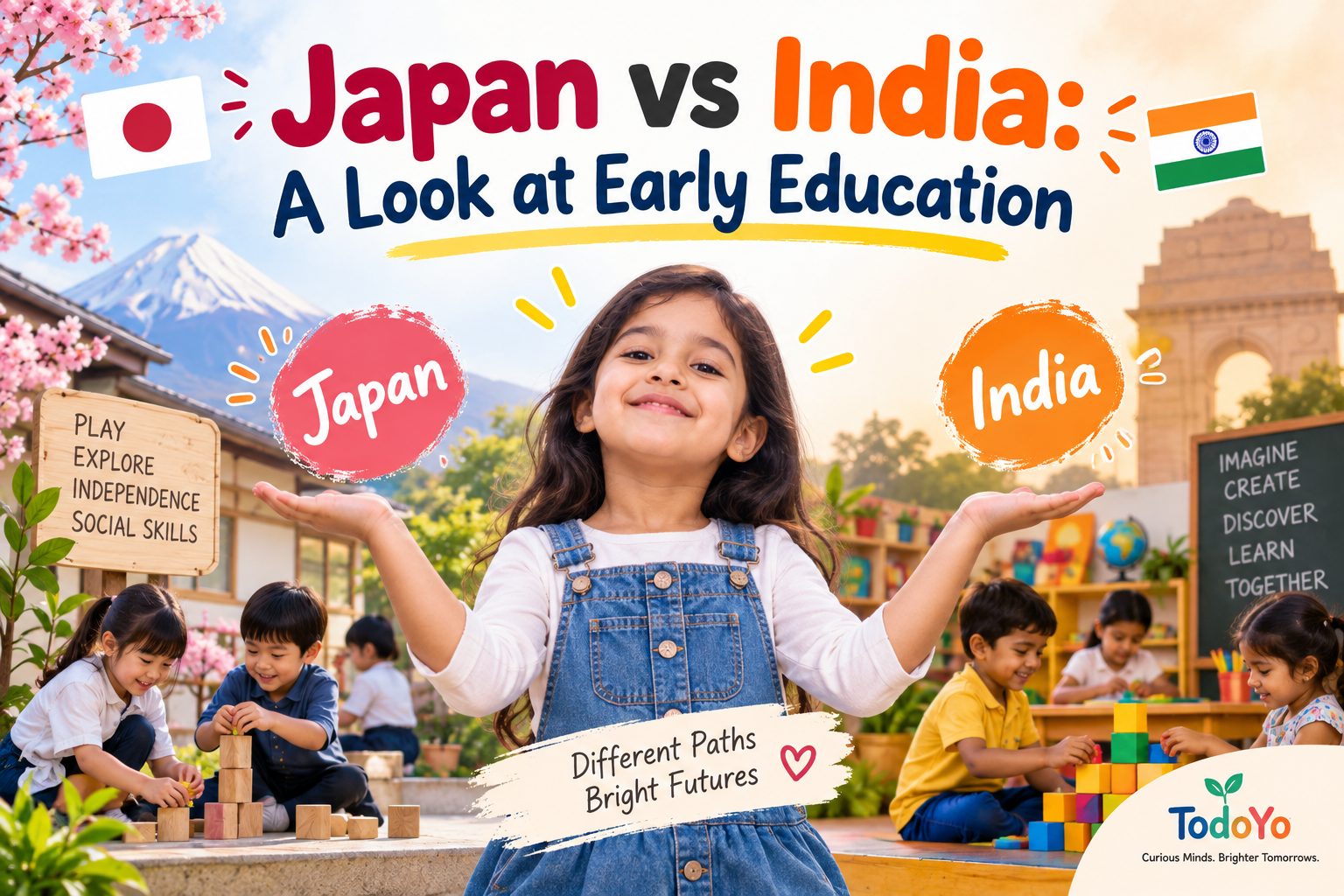
Japan and India have different educational traditions and approaches to early childhood education. Looking at both gives us an opportunity to understand how young children experience learning in different environments.
Early Education in Japan
Japanese early childhood education places considerable importance on play, daily experiences, social interaction, and independence.
Children are encouraged to participate in activities that allow them to explore their surroundings and interact with other children. Outdoor play, creative activities, group activities, storytelling, music, movement, and everyday tasks can all become part of the learning experience.
Rather than focusing heavily on academic instruction at a very young age, early education often provides children with opportunities to learn through experiences and activities.
Children may also be encouraged to take responsibility for simple tasks, follow routines, work together, and gradually become more independent.
Early Education in India
Early childhood education in India has traditionally included activities such as learning alphabets, numbers, rhymes, stories, drawing, and basic writing.
However, the approach to foundational education in India is changing. The National Education Policy 2020 and the National Curriculum Framework for the Foundational Stage place greater emphasis on play-based, activity-based, and inquiry-based learning.
Children are encouraged to learn through stories, art, music, movement, conversation, exploration, games, and hands-on activities.
This means that early education does not have to be limited to books and worksheets. Everyday experiences can also become opportunities for children to learn.
Learning Through Play
Play is an important part of early childhood because it allows children to learn while actively participating.
Building with blocks can introduce ideas about shape, size, balance, and space.
Playing with other children can develop communication, cooperation, and sharing.
Pretend play can encourage imagination and language.
Outdoor activities can help children observe nature and understand their surroundings.
The activity may look simple, but children can be developing several skills through the experience.
A Simple Example: Learning From Leaves
Imagine a teacher takes a group of children outside and finds a few fallen leaves.
Instead of simply telling the children that the leaves come from different trees, the teacher can encourage them to observe and compare.
The teacher might ask:
“What differences can you see?”
Children may notice that some leaves are big, some are small, and others have different shapes, colours, or textures.
The teacher can then ask:
“Why do you think they are different?”
The children may come up with different ideas. Rather than immediately giving them the correct answer, the teacher can encourage them to look at the trees, collect a few leaves, compare them, and discuss what they observe.
Through one simple outdoor activity, children are practising observation, communication, comparison, questioning, and independent thinking.
The teacher creates the opportunity, guides the children with questions, and allows them to explore.
This is how an ordinary activity can become a meaningful learning experience.
The Role of the Teacher
The teacher’s role in early childhood education is not only to provide information. It is also to create an environment where children feel comfortable exploring and expressing their ideas.
Children need guidance, but they also need opportunities to think independently.
Instead of always providing an answer, teachers can ask questions such as:
“What do you think?”
“What could you try?”
“What happens if we change this?”
These simple questions can encourage children to observe, think, and explore further.
The Role of Parents
Learning does not stop when a child leaves the classroom.
Parents can create similar opportunities at home through everyday activities. Cooking, gardening, drawing, building, reading stories, sorting objects, or simply observing the world outside can become learning experiences.
A parent does not need to turn every activity into a lesson. Sometimes, simply being curious together is enough.
A question such as “Why do you think this happened?” can lead to a meaningful conversation.
What Early Education Should Encourage
The purpose of early childhood education is not only to prepare children for the next grade.
It is also about developing the foundations that support future learning.
Children need opportunities to:
- Explore their surroundings
- Ask questions
- Express their ideas
- Develop their imagination
- Work with others
- Make choices
- Solve simple problems
- Learn from their experiences
Japan and India have their own educational systems and cultural approaches. There is no need to copy one system completely.
Instead, we can look at the ideas that support healthy early development and consider how they can be adapted to different learning environments.
Building a Meaningful Learning Environment
Early learning can happen in many places—a classroom, a playground, a garden, a home, or even during a simple conversation.
What matters is giving children opportunities to participate rather than only observe, to explore rather than only receive instructions, and to ask questions rather than only remember answers.
The early years are a time when children are discovering not only what the world is, but also how to learn about it.
Creating opportunities for play, exploration, creativity, and hands-on experiences can help make those early years rich and meaningful.
At TodoYo, we believe that learning begins with curiosity and grows through exploration, experience, and doing.




Leave a Reply